
Hagai Bergman, September 2021
Based on “Deep Brain Stimulation Offers Parkinson’s Patients New Hope,” by Leah Jessen, Digital Communications Manager, and Matthew R. Bailey, President of the Foundation for Biomedical Research.
Research in Monkeys Laid the Foundation for Electrical Brain Stimulation Treatments for Parkinson’s Disease
Deep brain stimulation (DBS) is a treatment built on decades of research in humans and animals. It offers significant benefits to patients with Parkinson’s disease, a neurological disorder caused by disruptions in the brain's neural circuits involved in movement control.
DBS involves implanting electrodes in the brain and uses electrical stimulation to modulate signals within neural circuits to and from specific targeted brain regions, thereby improving motor symptoms, according to the National Institute of Neurological Disorders and Stroke (NINDS).
Symptoms of Parkinson’s disease include tremors in the limbs, difficulty initiating and performing movements, slowness of automatic movements, muscle rigidity, and a forward-stooped posture. Symptoms vary among patients and may change over time in each individual. Parkinson’s disease is progressive, affecting more than one million people in the United States and over ten million worldwide.
The following brief history of medical treatments for Parkinson’s disease explains how scientists identified the most effective brain targets for successful DBS treatment in patients with Parkinson’s disease.
The surgeon James Parkinson first described the disease in 1817, referring to it as “shaking palsy.” A fundamental understanding of its underlying causes remained elusive until the twentieth century.
Among the earliest treatments for Parkinson’s disease, from the 1930s through the 1950s, were surgical procedures involving the destruction of specific brain regions. These operations focused on a group of structures known as the basal ganglia, located deep within the brain. The basal ganglia are components of circuits that include the cerebral cortex, brainstem, and thalamus and are involved in controlling movement and behavior (see Figure 1).
However, the success of these surgical interventions was limited because surgeons did not yet know precisely which regions of the basal ganglia were responsible for movement control.
A major breakthrough came in the 1960s, not through surgery, but through the introduction of a medication called L-dopa (levodopa), following the discovery of dopamine in the basal ganglia and its depletion in patients with Parkinson’s disease.
This medication, which replenished dopamine levels in the brain, dramatically reduced the symptoms of Parkinson’s disease and eventually largely eliminated the need for surgery, except in patients whose tremors did not respond to medication.
However, prolonged use of L-dopa led to complications in many patients, including involuntary movements and motor fluctuations caused by the premature wearing-off of the medication’s therapeutic effects.
Basic research involving laboratory monkeys contributed to a better understanding of the neural mechanisms underlying Parkinson’s disease and helped pave the way for the development of new treatments. Scientists studied monkeys because the organization of their basal ganglia closely resembles that of humans. (Figure 1 illustrates the human basal ganglia.)
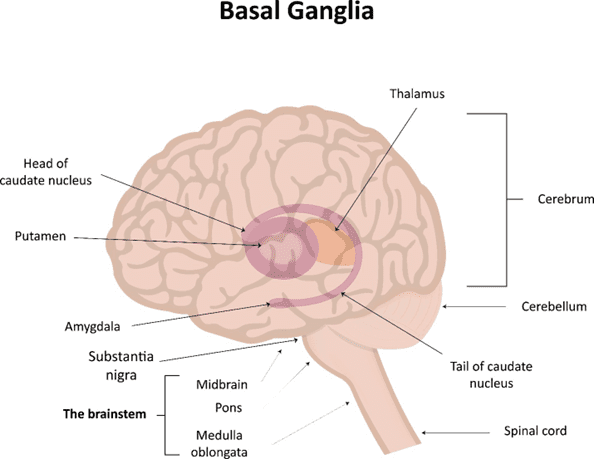
Hagai Bergman, September 2021
This research challenged and ultimately overturned the early notion that a single center of neurons controls functions such as movement. Instead, scientists discovered that movement control depends on multiple groups of neurons connected through highly specific pathways.
Changes in the activity of these neurons play an important role in controlling movement and in the development of movement disorders.
These interconnected groups of neurons form circuits, much like a series of connected components on an electronic circuit board. Repairing such a circuit board requires identifying and fixing malfunctioning components. Similarly, the scientists’ task was to identify the groups of neurons (the components), determine the connections between them (the circuits), and understand how these networks relate to movement.
Today, the medical community recognizes many movement disorders as “circuit disorders,” resulting from abnormal activity within neural circuits. Most experts in the field believe that the primary signs and symptoms of neurological and psychiatric disorders arise from disturbances in neural circuit function.
For more than 40 years, scientists have mapped and studied neural circuits within the basal ganglia of monkeys. The anatomical structure of the monkey brain closely resembles that of the human brain, making nonhuman primates among the most relevant animal models for understanding human brain function.
A breakthrough occurred in the early 1980s with the development of a nonhuman primate model of Parkinson’s disease that reproduced neurological symptoms similar to those observed in people with the disease.
Experiments involving monkeys helped explain how dysfunction in a specific neural circuit involving part of the basal ganglia, known as the subthalamic nucleus (STN), can produce symptoms of Parkinson’s disease.
Creating a lesion in the subthalamic nucleus reduced symptoms in the monkey model of Parkinson’s disease, thereby identifying a new and highly effective target for surgical intervention.
Surgical inactivation of the same region in human patients also reduced symptoms of the disease. However, this procedure sometimes caused significant and persistent side effects.
Surgeons therefore turned to electrical stimulation to investigate whether deep brain stimulation of the subthalamic nucleus could alleviate symptoms without permanently destroying brain tissue.
Indeed, electrical stimulation proved effective, producing therapeutic results similar to those achieved through surgical inactivation.
Patients receiving deep brain stimulation experience a substantial reduction in Parkinson’s disease symptoms for at least five years following surgery. Studies have also reported improved quality of life compared with medical treatment alone.
Deep brain stimulation of the subthalamic nucleus has therefore become a life-changing treatment for many patients with Parkinson’s disease. More than 200,000 patients worldwide have successfully undergone this treatment.
In Israel, DBS was included in the national health benefits package in 2003, and nearly 800 patients had already received the treatment as of the time of writing.