
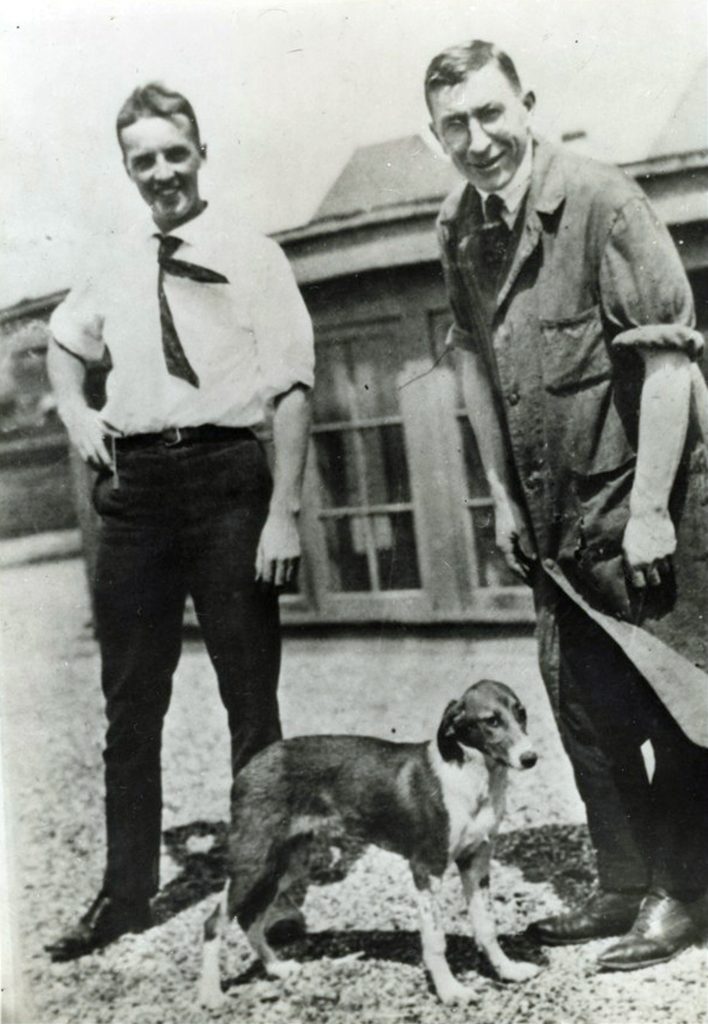
Frederick Banting and Charles Best with one of the research dogs.
Diabetes
Diabetes is a disease characterized by high levels of glucose (a simple sugar) in the blood. All forms of diabetes involve disturbances in insulin production or function.
Insulin
Insulin is a hormone secreted by the beta cells of the pancreas into the bloodstream.
The role of insulin: Insulin regulates the concentration of nutrients, such as sugars and fats, in the blood. It promotes the uptake of glucose into cells, thereby reducing blood glucose levels. In the absence of insulin, blood glucose levels rise above the healthy range, potentially causing damage to blood vessels and leading to complications such as limb amputations, blindness, impaired heart and kidney function, and other serious health problems.
A Century Since the Discovery of Insulin
In 2021, we commemorate the 100th anniversary of the discovery of insulin. This discovery involved isolating insulin from the pancreas, demonstrating its biological role in regulating glucose metabolism and blood glucose levels, and developing its use as a life-saving treatment for patients with diabetes.
The discovery resulted from research conducted at the University of Toronto in Canada. Its early stages involved experiments in dogs. The first stage, in May 1921, involved isolating insulin from the pancreas of a healthy dog. The second stage involved injecting the newly obtained substance into a diabetic dog and successfully regulating its blood glucose levels. The culmination of this research was the preparation of insulin from cattle pancreases and the successful treatment of a young patient with diabetes in January 1922.
Noa Meged Gets Connected to an “Artificial Pancreas”
There was great excitement in the Meged household on Tuesday morning. The family was preparing to leave for a diabetes center at a major hospital in central Israel, where Noa would be fitted with an “artificial pancreas.”
Noa, a 16-year-old eleventh-grade student, had been living with diabetes for ten years. In recent years, she had been administering insulin using an insulin pump. Insulin was her lifeline. She carefully monitored her blood glucose levels and had been using a continuous glucose monitor for the past year.
Her physician at the diabetes center, Dr. Oded Nir, described her as one of his most conscientious patients. Noa maintained a healthy diet, was one of the leading players on her school's basketball team, and tried to maintain a positive attitude whenever possible. “Personal responsibility” was her motto.
Because of her condition, and thanks to her curiosity and awareness, Noa had developed a strong interest in every aspect of diabetes, from the history of the disease and its treatments to the latest advances in diabetes care.
Noa had type 1 diabetes, formerly known as juvenile diabetes. This form of the disease results from an autoimmune process in which the body's immune system destroys the cells responsible for producing and secreting insulin.
Near the entrance to the clinic's waiting room hung two large posters.
The first was titled “100 Years Since the Discovery of Insulin” and featured an early insulin bottle alongside a photograph of a glass syringe with an enormous needle.
The second showed a young man connected to a hybrid insulin pump on one side of his abdomen and a continuous glucose monitor on the other. He was holding a smartphone.
Dr. Nir came out to greet Noa and her parents. Before entering his office, Noa said, “I'm very excited about getting this new equipment today, but when we're finished, I have a suggestion and a request concerning the posters hanging here.”
Installing the equipment did not take very long, but the training session was considerably longer. There were many explanations, numerous instructions for proper use, and discussions of possible technical problems.
A new world had opened up for Noa: greater freedom, but also much greater responsibility.
Noa and Dr. Nir agreed to remain in close telephone contact and meet again the following day to review her initial experience and continue the training.
Dr. Nir reminded Noa about her suggestion regarding the posters. However, she replied that she was too tired and excited to explain her ideas properly and that the subject required a lengthy discussion. She suggested arranging a separate meeting, and they agreed to do so.
The following day, Noa returned to the clinic for another appointment. This was followed by a week of daily telephone conversations. At a subsequent follow-up appointment, feeling confident that she was making good progress with the new system, Noa arranged a meeting with Dr. Nir to discuss the posters displayed in the clinic.
Noa was studying biology at high school. When her class covered diabetes, she had volunteered to give a presentation to her classmates about recent advances in its treatment.
What Did Noa Want to Suggest About the Posters?
Noa explained to Dr. Nir that she believed a diabetes clinic was the appropriate place to honor the pioneers of scientific and medical research whose discoveries had made the tremendous progress in diabetes treatment possible.
Her proposal raised two important questions: Who should be recognized as the pioneers of this research? And who else deserved recognition for making these scientific breakthroughs possible?
Noa emphasized that the development of the artificial pancreas was an enormous achievement that improved the daily lives of people with type 1 diabetes, a condition affecting more than 1.5 million people worldwide, according to the figures cited in the original article.
After thoroughly studying the history of diabetes and the breakthroughs that had led to modern treatments, she concluded that the discoverers of insulin, a century earlier, deserved recognition above all.
Equally important, however, were the scientists who had established that the pancreas was the source of the internal secretion responsible for regulating blood glucose. Their discovery had emerged from research conducted approximately 30 years before insulin was isolated.
Dr. Nir quickly calculated the number of researchers involved and asked, “So you're suggesting that we hang photographs of six people?”
Noa and Moran replied that there was another very important photograph that should be included, one that would highlight those whose contribution had been essential to discovering the role of the pancreas and ultimately insulin itself: the research dogs.
It was thanks to research involving these animals, they explained, that people with type 1 diabetes around the world could now survive through daily administration of external insulin.
Noa showed Dr. Nir the text she wanted to display alongside the photographs: The History of the Discovery of Insulin.
The History of the Discovery of Insulin
The isolation of insulin from the pancreas was the result of biological research that ultimately produced a major medical breakthrough.
Two scientific studies were particularly important in achieving what is considered one of the most significant accomplishments in biological research.
The first was conducted in 1889 by researchers Oskar Minkowski and Josef von Mering at the University of Strasbourg, then part of Germany.
The research involved dogs and was initially intended to improve the understanding of fat absorption in the intestines, with the goal of helping patients who had difficulty absorbing dietary fats.
The researchers focused on the function of digestive enzymes secreted by the pancreas, the major exocrine gland associated with digestion.
Their experimental approach involved completely removing the pancreas from dogs and comparing the fats and their composition in the food and excretions of animals with and without a pancreas.
Remarkably, the very first experiment produced findings that would revolutionize the understanding of the biology of diabetes.
The dog recovered from surgery but began urinating continuously throughout the laboratory.
Minkowski examined the urine and discovered that it contained large quantities of glucose and ketone bodies, both characteristic of diabetes.
This result was unexpected. Von Mering and Minkowski therefore repeated the experiment with several additional dogs and observed the same phenomenon.
They concluded that complete removal of the pancreas caused diabetes, a condition they termed “pancreatic diabetes.”
Their next conclusion was that the pancreas contained a substance responsible for regulating carbohydrate metabolism throughout the body. They hypothesized that this substance was released internally from the pancreas and acted on other organs.
The term “hormone” would not be introduced until more than a decade later.
The research findings were published in a scientific journal and presented at international conferences that same year, in 1889.
However, many other scientists questioned these conclusions and proposed alternative explanations.
To strengthen their findings, von Mering and Minkowski conducted additional experiments in dogs.
After completely removing a dog's pancreas, the researchers implanted a small portion of pancreatic tissue beneath the skin of the same animal's back, a procedure known as autotransplantation.
The dog did not develop diabetes.
Several days later, the researchers removed the transplanted pancreatic tissue. The dog subsequently developed diabetes.
Once the findings of von Mering and Minkowski gained acceptance within the scientific community, numerous researchers attempted to isolate the pancreas's “internal substance,” which regulated carbohydrate metabolism, with the aim of developing a life-saving medicine.
Scientists understood that successful preparation of an active extract depended on preserving the biological activity of this internally secreted substance.
The substance originated in clusters of pancreatic cells known as the islets of Langerhans, which account for only approximately 2% of pancreatic cells.
A major challenge was that the substance could be broken down by the powerful digestive enzymes present in the much larger exocrine portion of the pancreas.
A young Canadian physician, Dr. Frederick Grant Banting, developed an idea for reducing the activity of these digestive enzymes.
In May 1921, he began working in the laboratory of the distinguished physiologist Professor John James Richard Macleod at the University of Toronto, assisted by medical student Charles Herbert Best.
Banting's idea was to cause degeneration of the pancreas's exocrine cells in dogs by tying off the duct connecting the pancreas to the duodenum for seven to ten weeks.
In the second stage, the pancreas was removed and processed to produce an extract under cold conditions using physiological Ringer's solution, a salt solution containing essential minerals, including sodium, potassium, calcium, and magnesium.
The third and decisive stage involved intravenously injecting the extracted fluid into a dog whose pancreas had previously been removed, causing it to develop diabetes.
The laboratory work included surgical procedures on dogs, preparation of pancreatic extracts, measurements of blood glucose levels, and additional blood tests.
For the first time in history, the liquid extract prepared by Banting and Best successfully reduced blood glucose levels in diabetic dogs and maintained improved glucose regulation over time.
Banting and Best also demonstrated that pancreatic extracts obtained from cats and rabbits produced similar results when tested in dogs.
An important step toward treating human patients was the development of an active extract from cattle pancreases.
The initial extract, which had been effective in dogs, was administered by subcutaneous injection to a young patient, Leonard Thompson, on January 11, 1922.
He received 15 milliliters of a grayish liquid, but there was no significant improvement in his elevated blood glucose levels.
Dr. James Bertrand Collip, a biochemist who had joined the research team, subsequently prepared a more concentrated and purified extract.
This improved preparation was injected into Leonard Thompson on January 23, 1922.
The effect on his blood glucose levels was dramatic.
Thompson received another injection the following day, followed by nine additional daily injections beginning on January 27, 1922.
Ketone bodies disappeared from his blood, and his glucose levels fell to within the normal range.
By March, seven additional children with diabetes who had been close to death had received treatment with similarly successful results.
The breakthrough in life-saving diabetes treatment had been achieved.
The medical, and above all human, significance of this achievement was captured by Dr. Elliott Joslin of Boston:
“By Christmas of 1922, I had seen so many cases of near resurrection that I realized I was witnessing the vision of the dry bones described by the prophet Ezekiel.”
In our own time, approximately 130,000 new cases of type 1 diabetes are diagnosed worldwide each year, according to the figures cited in the original article.
The lives of these patients can be saved through insulin treatment, made possible by the scientists who discovered insulin and the dogs whose involvement was essential to the research.
Honoring the Past and Looking Toward the Future
Dr. Nir considered Noa's proposal carefully.
“First of all,” he said, “the text accompanying the photographs is rather long. But considering that patients often spend quite a bit of time waiting to see the doctor, perhaps we can leave it as it is.”
“As for the photographs, I have another suggestion: one photograph representing the achievements of the past, and another representing the present.”
“For the past, instead of displaying six separate photographs of the researchers, all of whom certainly deserve great recognition, perhaps we could display a single photograph showing Banting and Best together with one of the research dogs. Three central figures in this remarkable achievement.”
“And for the second photograph, representing the present…”
Dr. Nir paused for a moment.
“Not another photograph of an artificial pancreas. We should show something human.”
“What do you think, Noa? Perhaps we could display a photograph of you shooting a basketball into the hoop, as a symbol of hope for people with diabetes: the hope of leading ordinary, active lives thanks to the progress achieved over the past century, and the advances that will continue to emerge through the determination of people living with diabetes and the scientists working to improve their lives.”
Noa said she would have to think about it.
References
1. Banting, F. G., & Best, C. H. (1922). The internal secretion of the pancreas. The Journal of Laboratory and Clinical Medicine, 7(5), 251–266.
2. Banting, F. G., Best, C. H., Collip, J. B., Campbell, W. R., & Fletcher, A. A. (1922). Pancreatic extracts in the treatment of diabetes mellitus: Preliminary report. Canadian Medical Association Journal, 12, 141–146.
3. Minkowski, O. (1989). Historical development of the theory of pancreatic diabetes by Oscar Minkowski, 1929: Introduction and translation by Rachmiel Levine. Diabetes, 38(1), 1–6.
4. Bliss, M. (1993). The history of insulin. Diabetes Care, 16(Suppl. 3), 4–7.
5. Roth, J., Qureshi, S., Whitford, I., et al. (2012). Insulin’s discovery: New insights on its ninetieth birthday. Diabetes/Metabolism Research and Reviews, 28, 293–304.